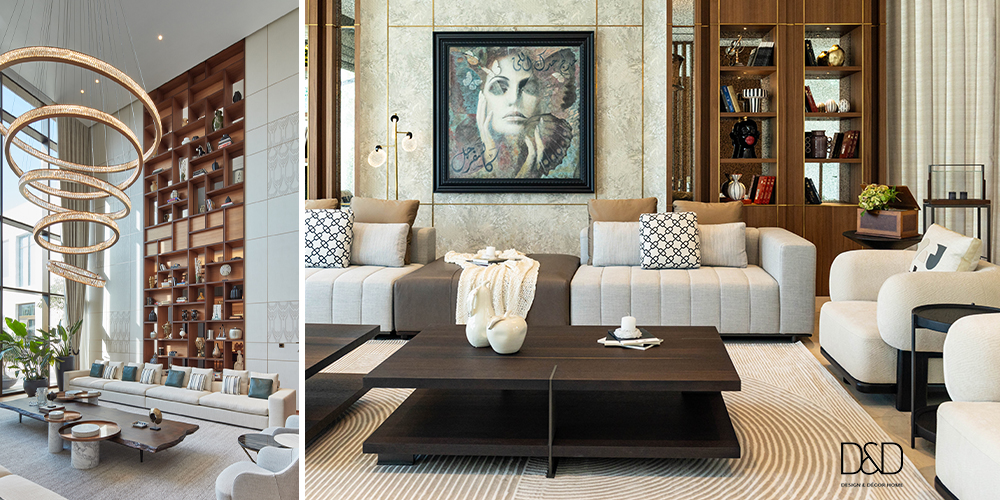
Custom Sofa Designs: Round Shape, L-Shaped, Curved, Modular
Most people choose a sofa by color first. Then it arrives, and it blocks the balcony door by ten centimeters.
Shape matters more than people expect. It decides where everyone sits, how they talk to each other, and whether your living room feels open or crowded. When you go custom, you settle that question before anything gets built.
Here's an honest look at the four shapes people ask us about most, and where each one actually works.
Why Shape Comes Before Fabric
A sofa is usually the biggest piece in the room. Everything else gets arranged around it.
In Dubai, layouts vary a lot. A one-bedroom in JLT might give you a single 3.2-meter wall and not much else. A villa in Arabian Ranches could have a double-height lounge with no obvious "front." A standard showroom sofa wasn't designed for either.
That's the real case for a custom sofa. You aren't stuck with a fixed length, depth, or arm style. You start with the room and work backward.
The Round Sofa: Made for Conversation
Round sofas are everywhere right now, and there's a practical reason. Nobody ends up at the far end, craning their neck to join in. They suit rooms where the sofa floats instead of sitting against a wall. Think of a large lounge, a majlis-style seating area, or the entrance hall of a villa.
Round sofas need breathing room. If yours is freestanding, leave at least 90 cm of walking space behind it. They're also tricky to cushion. A good maker shapes the seat foam to follow the curve. Flat foam cut into wedges tends to sag at the joins within a year, so ask about this before you order.
Full circles are rare in homes. Most of our clients go for a half-round or three-quarter design facing a coffee table, a fireplace wall, or a view.
The L-Shaped Sofa: The Family Workhorse
If you have kids, weekend guests, or a habit of falling asleep halfway through a film, an L-shaped sofa earns its place. It tucks into a corner and uses space that would otherwise sit empty. In open-plan apartments, it also creates a natural divider between the living and dining zones, no wall needed.
The question people forget is which side the return goes on. That depends on your TV, your windows, and the route people take through the room. Stand in the space and picture it. Also confirm how your maker defines "left-hand" and "right-hand," because conventions differ.
With a custom build, you set each arm length separately. A 2.8 m × 1.9 m L sits very differently from a 3 m × 3 m one, and that difference often decides whether your coffee table fits.
The Curved Sofa: Softer Lines, Bigger Presence
A curved sofa isn't the same as a round one. It's a gentle arc, sometimes placed near a wall, sometimes floating. It softens rooms full of hard edges, and Dubai apartments have plenty: square columns, floor-to-ceiling glass, straight kitchen islands. A curved back breaks all that up.
Curves look best in bouclé, velvet, or a tight-weave fabric that hugs the frame. Loose, slouchy covers fight the shape and wrinkle at the bends.
One drawback nobody mentions in showrooms: curved sofas seat fewer people than their width suggests. The inner arc is shorter than the outer one. If you need room for six, measure along the seat line, not the overall width.
The Modular Sofa: For People Who Move Things Around
Modular sofas come in separate sections, such as armless seats, corner units, chaises, and ottomans, that clip or bolt together.
This is the shape for renters and anyone who expects their home to change. Today's two-bedroom in Al Barsha could be a townhouse in Mirdif in three years. A modular sofa can go from a straight three-seater to an L to a U by adding a piece instead of replacing everything.
It's easier to deliver, too. Anyone who has watched movers try to tilt a one-piece sofa into a tower lift will understand. The trade-off is gaps. Cheaper modular sets drift apart the moment you sit down. Ask for solid connectors, and check that every section shares exactly the same seat height.
Matching the Shape to Your Room
If you're still torn, start with the room rather than the sofa. One long wall in a compact apartment usually suits a straight or modular design better than a bulky L.
A corner with a view works well with an L-shape, with the return facing the window. A large open lounge with no clear wall to anchor against is where round and curved sofas shine. And if there's a move on the horizon, modular is the safest bet.
What Makes a Custom Sofa Last?
Shape is half the decision. The other half is what's inside.
Sunlight through big windows fades dark fabrics quickly, so consider UV-resistant performance fabrics or keep the sofa out of direct afternoon sun. Fine dust gets into everything here, which makes removable, washable covers worth the small extra cost.
Foam density matters more than most buyers realize. High-density foam holds its shape for years. Low-density foam feels lovely in a showroom and goes flat by the second summer.
The frame should be kiln-dried hardwood or good-quality engineered wood, not chipboard. Ask what yours is made of. A reliable maker will answer without hesitating.
Finally, measure the way in. This includes door width, lift dimensions, and any tight corridor turns. We'd much rather design a sofa in two parts than see one stuck in a lobby.
Related Blogs
 September 21, 2026
Wood Joinery for Modern Interiors: Sleek, Practical, and Stylish Solutions

 September 14, 2026
D&D Home, the All-in-One Interior Partner for Homeowners and Professionals
 September 07, 2026
Dubai Interior Design Trends: How to Achieve Muted Luxury with Modern & Classic Furniture
 September 02, 2026
The 2026 Summer-Fall Interior Colour Guide for Dubai Homes