Modern Lighting Ideas to Elevate Your Home Décor
Lighting is often the last decision in a furnishing project, yet it shapes how a room feels more than almost anything else. The same sofa, rug, and artwork can look warm and composed at 8 p.m. or flat and clinical. It depends on where the light comes from and how it falls. Dubai homes are designed around abundant daylight, so evening lighting plans often get less attention than they deserve. That is a problem, because evening is when most families actually use their living and dining spaces.
Modern lighting design rests on one principle: build the room in layers. Ambient light sets the overall level. Task light supports specific activities. Accent light draws the eye to texture, art, and architecture. Each of the five fixture types below plays a distinct role in that system.
Chandeliers:
A chandelier earns its place when it relates to the space beneath it. Over a dining table, the fixture should measure roughly half to two-thirds of the table’s width. Its lowest point should hang 30 to 36 inches above the surface. In a double-height villa entrance, scale up with confidence, since an undersized piece in a tall void looks like an afterthought.
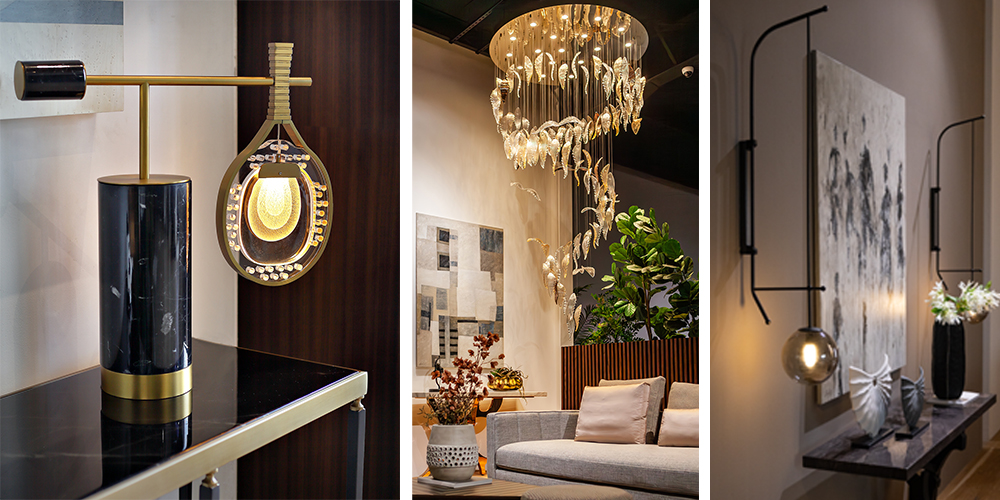
Contemporary chandeliers have largely moved away from cascading crystal toward sculptural forms. Linear brass bars suit long dining tables, clustered glass globes work well in living rooms, and organic rings soften strict architecture. When choosing, consider how the fixture looks switched off, because it spends most daylight hours as a sculpture rather than a light source. Our chandelier collection includes pieces scaled for both apartments and grand villa interiors.
Always fit a dimmer. At full output during a dinner party, a chandelier flattens faces and food. At around 40 percent, it creates intimacy without leaving the room dark.
Custom Pendants:
Pendants solve problems that standard fixtures cannot. A kitchen island, a reading nook beneath a staircase, and a bedside where floor space is tight all benefit from light suspended exactly where it is needed.
For islands, two or three pendants usually work best. Space them 24 to 30 inches apart and hang them 30 to 36 inches above the countertop, so they light the work surface without blocking sightlines across the room. Bedside pendants free up nightstand surfaces and give bedrooms a hotel-like polish, as long as they drop to around shoulder height when you are seated.
Custom pendants go further. You can specify drop length, finish, shade material and cluster arrangement to suit irregular ceilings or a particular design story. A cluster of staggered blown-glass pendants in a stairwell, for example, can carry light down three floors while doubling as an art installation. Explore our pendant lights, or speak to our bespoke design team about a configuration made for your space.
Wall Lights:
Wall lights are the most underused layer in residential interiors. Lifting light off the ceiling adds depth and gives a room a gentler, more flattering glow.
Use them in pairs to frame a mirror, a console or a headboard. In corridors, sconces spaced 8 to 10 feet apart provide soft wayfinding light at night, without the glare of recessed downlights. Up-and-down sconces are especially effective on textured surfaces such as stone cladding, limewash plaster and fluted panels. The beam grazes the surface and reveals its relief.
Mount most wall lights about 60 to 66 inches from the floor, then adjust for ceiling height and the furniture below. Plug-in versions with neatly routed cords are useful in rented apartments where rewiring is not an option. Browse our wall lights to compare finishes in brushed brass, matte black, and opal glass.
Floor Lamps:
A floor lamp corrects what overhead lighting misses. Placed behind a lounge chair or at the end of a sofa, it brings light down to eye level and defines a zone within an open-plan living room.
Arc lamps reach over a sofa or coffee table without a ceiling connection. That makes them ideal where building codes or structure limit electrical work. Slim torchieres bounce light off the ceiling for a soft ambient wash, while tripod and sculptural designs stand as objects in their own right.
For reading, choose a lamp with an adjustable head, and position the bottom of the shade just below eye level when seated. In a living room corner, a floor lamp also balances the visual weight of a large sofa or cabinet on the opposite side. Our floor lamps cover reading, ambient, and statement designs.
Table Lamps:
Table lamps contribute far more to atmosphere than their size suggests. A pair on a console or sideboard creates symmetry. A single lamp on a desk or side table adds a pool of warm light that makes a large room feel lived in.
Proportion matters. On bedside tables, the bottom of the shade should sit roughly at chin height when you are sitting up in bed, which usually means a lamp 24 to 27 inches tall. Ceramic, travertine, and smoked-glass bases add material interest, and linen shades diffuse light far more gently than opaque metal ones.
Table lamps are also the simplest way to refresh a room without any structural work. Explore our table lamps alongside our home décor collection to coordinate finishes across a space.
Getting the Technical Details Right
Fixtures only perform as well as the bulbs inside them. For living areas and bedrooms, specify warm white at 2700K to 3000K, and reserve 4000K for kitchens, laundry rooms and workspaces. Choose LEDs with a color rendering index (CRI) of 90 or higher, so fabrics, timber and skin tones look true. Keep color temperature consistent within each room, since mixing 2700K and 4000K in one space makes it feel disjointed.
Plan circuits so each layer can be controlled separately, and put dimmers on every ambient and accent circuit. If you are planning a home fitout, this is the stage to position electrical points for wall lights and pendants. Relocating them after plastering and painting is costly and disruptive.
Related Blogs
 October 12, 2026
Upholstery and textile work. New trends/ colors for Fall/winter

 October 05, 2026
Custom Sofa Designs: Round Shape, L-Shaped, Curved, Modular
 September 21, 2026
Wood Joinery for Modern Interiors: Sleek, Practical, and Stylish Solutions
 September 14, 2026
D&D Home, the All-in-One Interior Partner for Homeowners and Professionals